TikTok US Sale Did Not Create a Complete Break From ByteDance, Investigation Finds
TikTok’s long-awaited separation from its Chinese parent company ByteDance was supposed to settle one of the biggest controversies surrounding the platform in the United States.
Instead, a new investigation suggests that the relationship may be far more complicated than the January 2026 deal initially appeared.
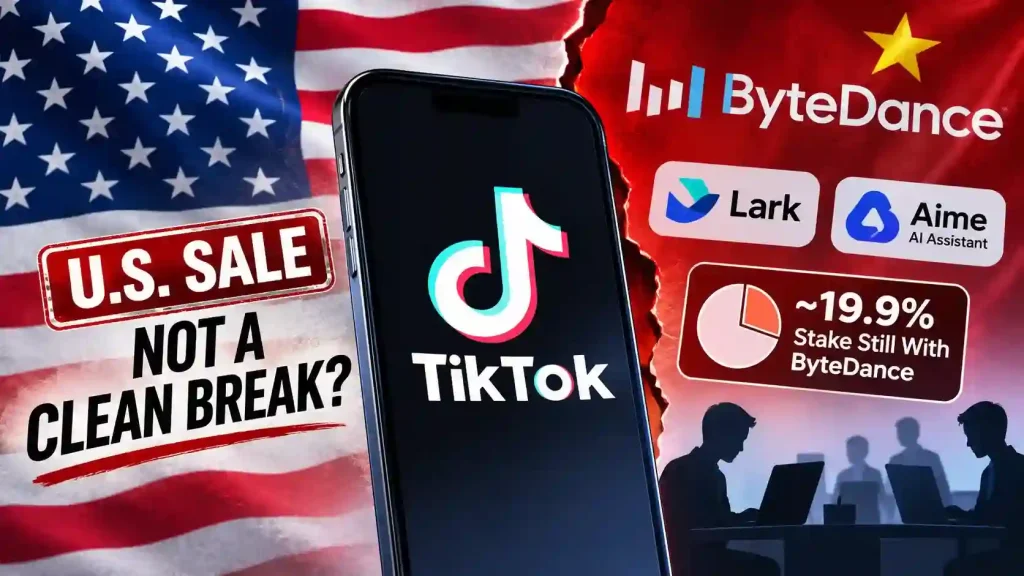
According to a POLITICO investigation published in October 2026, TikTok’s U.S. employees continue to work closely with the company’s global organization and still use workplace tools developed by ByteDance, including the internal messaging platform Lark and an AI assistant called Aime.
At the same time, ByteDance still owns 19.9% of the new TikTok U.S. joint venture.
The findings are unlikely to mean that ByteDance directly controls TikTok’s U.S. operation. The new company was structured to give U.S. investors majority ownership and responsibility for key areas such as U.S. data protection and content moderation.
However, the continued operational connections raise fresh questions about how complete the TikTok U.S. separation really is—and whether the deal fully addresses the national security concerns that triggered years of political and legal pressure.
What Happened to TikTok’s U.S. Business?
TikTok’s U.S. ownership saga lasted for years.
The U.S. government had argued that ByteDance’s ownership of TikTok created national security concerns because of the company’s Chinese origins and potential access to American user data.
After years of negotiations, legal challenges and deadline extensions, TikTok finalized a new U.S. joint venture in January 2026.
The new structure placed the American operation under TikTok USDS Joint Venture LLC.
Oracle, Silver Lake and Abu Dhabi-based investment firm MGX each took a 15% stake. Existing ByteDance investors also retained a significant position, while ByteDance itself kept 19.9% of the new venture.
The arrangement was presented as a major change in control.
The new U.S. company was given responsibility for protecting American user data, securing the recommendation algorithm, handling content moderation and overseeing software security for the U.S. platform.
For TikTok users, the immediate result was straightforward: the app continued operating in the United States.
But the ownership change did not mean that every connection with ByteDance disappeared.
POLITICO Investigation Raises New Questions
The latest concerns come from an investigation by POLITICO Magazine based on interviews with current and former TikTok employees as well as internal communications.
The investigation found that employees at TikTok’s U.S. operation continue to communicate and coordinate with colleagues within the broader global TikTok organization.
That cooperation reportedly includes discussions around new features, dangerous trends on the platform and content policies.
The most notable detail is that U.S. employees continue using Lark, an internal workplace communication platform created by ByteDance.
They also reportedly use Aime, an AI assistant developed by ByteDance that operates within the Lark environment.
For critics of the original TikTok deal, this is significant because the purpose of the U.S. restructuring was not simply to change who owned shares in the company. It was also intended to establish stronger operational and data boundaries between TikTok’s American business and ByteDance.
The investigation therefore raises an important question:
How independent is TikTok US if its employees are still relying on ByteDance-developed workplace technology and communicating regularly with the global organization?
TikTok Says Global Cooperation Is Necessary
There is another side to the story.
TikTok has argued that continued cooperation with its global organization is necessary for the U.S. version of the platform to function properly.
TikTok is a global service. American creators can reach audiences outside the United States, while businesses and creators depend on the platform’s international ecosystem.
The company has therefore maintained that interoperability is important to providing American users with a complete TikTok experience.
That distinction matters.
Using a ByteDance-developed communication tool does not automatically prove that ByteDance has access to protected U.S. TikTok data.
Likewise, communication between American and international employees does not necessarily mean that the U.S. joint venture is controlled by ByteDance.
The more important issue is what information can actually move through those systems, who can access it, and who controls the underlying infrastructure and permissions.
Why Lark and Aime Are Drawing Attention
Lark is not simply an ordinary consumer messaging application.
It is a workplace communication and collaboration platform developed by ByteDance and used by employees across its corporate ecosystem.
The fact that TikTok U.S. employees continue using it after the ownership restructuring has therefore attracted attention from people who have followed the company’s data-security controversy.
The situation involving Aime adds another layer.
According to the reporting, employees were instructed not to share sensitive information through Lark or Aime.
That policy could reduce the risk of sensitive U.S. information being exposed through those systems.
But critics may still question whether relying on employee behavior is enough for a system that was supposed to create strict separation.
A technical separation is generally stronger when sensitive information is automatically prevented from reaching an outside system rather than when employees are simply instructed not to put sensitive information there.
That distinction could become increasingly important if U.S. regulators or lawmakers decide to examine the arrangement more closely.
ByteDance Still Owns 19.9% of TikTok US
Another major point is ownership.
ByteDance did not completely exit the U.S. TikTok business.
It retained a 19.9% stake in the new joint venture.
That number is significant because the structure was designed to put the company below a controlling ownership threshold while allowing U.S. and other investors to hold the majority.
Oracle, Silver Lake and MGX each own 15%, giving those three investors a combined 45% stake.
Other investors connected to the previous ownership structure hold additional shares.
As a result, ByteDance is no longer the controlling owner of TikTok’s U.S. operation, but it has not disappeared from the ownership structure either.
This creates an important distinction between majority ownership and a complete corporate separation.
The January deal clearly changed who controls the U.S. venture.
The new POLITICO reporting, however, suggests that operational links with ByteDance remain.
What About TikTok’s Recommendation Algorithm?
The algorithm may ultimately be the most important unresolved part of the TikTok U.S. deal.
TikTok’s recommendation system is one of the company’s most valuable technologies. It determines which videos appear on users’ For You feeds and plays a central role in the platform’s popularity.
Under the new U.S. structure, TikTok says the U.S. company will retrain, test and update the recommendation algorithm using U.S. user data.
The algorithm is also supposed to be secured within Oracle’s U.S. cloud environment.
But questions remain over exactly how the underlying technology is separated from ByteDance.
One issue highlighted by the reporting is whether the algorithm was effectively licensed from ByteDance and how much involvement ByteDance engineers may still have in maintaining or updating it.
This is an important distinction.
An algorithm can be physically hosted in a U.S. cloud environment while still relying on intellectual property, software components or technical expertise originating from its former owner.
That does not necessarily violate the new structure, but it makes the meaning of “separation” more complicated.
Does This Mean ByteDance Still Controls TikTok US?
Not necessarily.
It would be inaccurate to conclude from the POLITICO investigation alone that ByteDance still controls TikTok’s American business.
The new venture is majority-owned by investors other than ByteDance, and the U.S. operation has been given authority over important areas including U.S. data protection and content moderation.
The U.S. Department of Justice has also taken the position that the TikTok U.S. Data Security Joint Venture functions independently of ByteDance and is majority-owned by American investors.
The issue is therefore less about whether ByteDance officially controls TikTok US and more about how independent the operation is in practice.
Corporate ownership, operational relationships, technology licensing and employee communication are separate questions.
A company can have new majority owners while continuing to rely on technology and systems inherited from its previous parent.
That appears to be the central issue raised by the latest reporting.
Why This Matters for TikTok Users
For ordinary TikTok users in the United States, the immediate experience may not change significantly.
The app continues to operate, creators can continue posting videos and businesses can continue using TikTok to reach customers.
But the ownership structure could matter over the long term.
If regulators conclude that ByteDance still has too much influence over TikTok US, the company could face additional scrutiny.
Questions could also arise around:
- U.S. user data protection
- Algorithm independence
- Access by ByteDance employees
- Software and infrastructure
- Cross-border employee communication
- Content moderation
- AI tools used by employees
- Future ownership changes
The biggest concern is not necessarily that Lark or Aime exist.
It is whether these tools create a pathway through which protected information, internal company data or sensitive user information could cross the intended U.S.-China boundary.
So far, the reporting does not establish that ByteDance currently has unauthorized access to protected U.S. TikTok user data.
That distinction is important.
TikTok’s US Future Is Still Not Completely Settled
The January 2026 deal solved the immediate question of whether TikTok would remain available in the United States.
But it may not have ended the broader debate over TikTok’s relationship with ByteDance.
The latest investigation shows why.
On paper, TikTok US has a new ownership structure, a U.S.-focused security framework and majority control outside ByteDance.
In practice, however, employees still communicate with the global TikTok organization and use ByteDance-developed workplace tools.
ByteDance also retains a 19.9% ownership position.
This creates a much more complicated picture than the simple idea of a complete sale.
The real test will be whether the new structure can maintain meaningful separation while still allowing TikTok to operate as a global platform.
What Happens Next?
The TikTok U.S. story is unlikely to end with the January 2026 transaction.
Lawmakers, regulators and security officials could continue examining how the joint venture operates and whether the safeguards promised during the sale are working as intended.
The algorithm will remain one of the biggest areas to watch.
So will the flow of information between TikTok’s U.S. employees and its global organization.
If future investigations establish that ByteDance has inappropriate access to protected U.S. information or meaningful influence over decisions that were supposed to be controlled by the U.S. joint venture, the political debate could quickly return.
On the other hand, if TikTok can demonstrate that these communication and technology links operate within strict security controls, the company may argue that global cooperation does not undermine the independence of the U.S. business.
For now, the evidence points to a more complicated reality than either side’s simplest narrative.
Final Thoughts
The TikTok U.S. sale changed the company’s ownership structure, but it did not erase every connection between TikTok US and ByteDance.
ByteDance still owns 19.9% of the U.S. joint venture, while POLITICO’s investigation indicates that U.S. employees continue working with global TikTok teams and using ByteDance-developed tools such as Lark and Aime.
That does not by itself prove that ByteDance controls TikTok US or has access to protected American user data.
However, it does show why the question of TikTok’s independence remains relevant.
The success of the U.S. deal will ultimately depend not only on who owns the shares, but also on who controls the technology, data, algorithms and day-to-day operations.
For TikTok users, creators and businesses in America, the app may have avoided a ban—but its relationship with ByteDance remains something worth watching.
TikTok’s U.S. future may no longer be about whether the app survives. The bigger question now is how independent it really is.