Judge Puts TikTok’s $400 Million Child Privacy Deal in Doubt
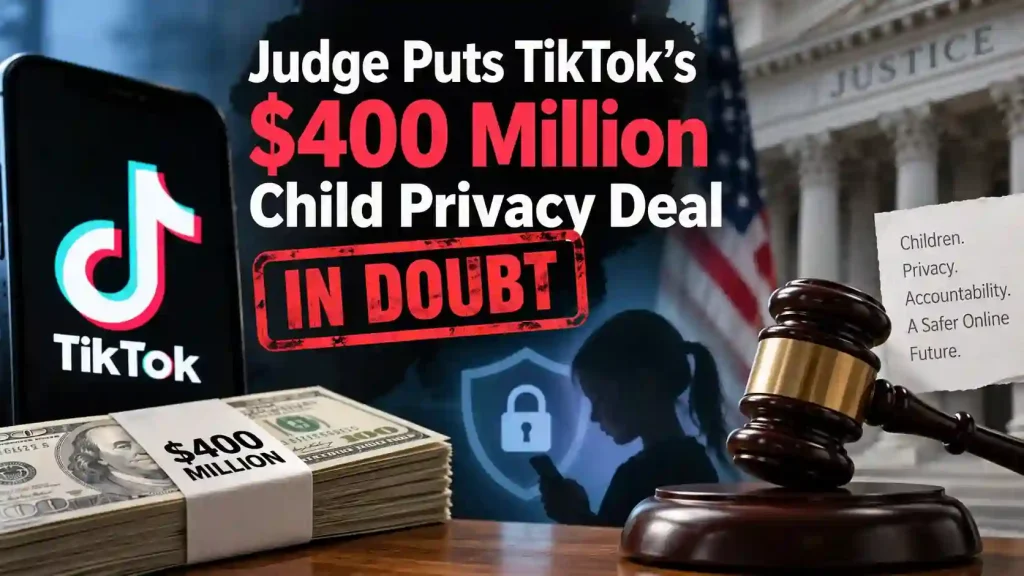
TikTok’s proposed $400 million child privacy settlement with the U.S. Department of Justice has hit an unexpected legal obstacle after a federal judge questioned whether ending an older privacy order would provide a sufficient long-term solution.
The proposed agreement was announced in August 2026 as a way to resolve allegations that TikTok and its parent company, ByteDance, violated U.S. laws designed to protect children’s online privacy. However, U.S. District Judge George H. Wu has indicated that he is not prepared to approve one important part of the deal in its current form.
The judge’s concern centers on a 2019 consent decree involving TikTok’s predecessor, Musical.ly. That order is still in effect and includes privacy-related reporting and record-keeping requirements. Under the proposed settlement, TikTok would pay $300 million immediately and another $100 million if the older decree were terminated.
What Is the TikTok $400 Million Settlement?
The U.S. Department of Justice announced the proposed $400 million settlement with TikTok and ByteDance on August 21, 2026.
The agreement was designed to resolve a federal lawsuit filed in 2024 over alleged violations of the Children’s Online Privacy Protection Act, commonly known as COPPA.
Under the proposed financial arrangement:
- TikTok would pay $300 million immediately.
- An additional $100 million would be paid if the 2019 consent decree were vacated.
- The agreement would resolve the DOJ’s current children’s privacy litigation.
- TikTok would continue operating under newer privacy and age-related safeguards.
The Justice Department described the settlement as one of the largest recoveries obtained in a COPPA case. It also said TikTok had made significant changes to its ownership, management, compliance operations and privacy practices since the government filed its lawsuit.
However, the allegations resolved by the settlement have not resulted in a final determination of liability. The DOJ specifically stated that the claims were allegations only.
Why Is the Judge Questioning the Deal?
The main issue is not simply the $400 million payment.
Instead, Judge George H. Wu is questioning whether it is appropriate to terminate the 2019 consent decree that was imposed on Musical.ly, the short-video service that later became part of TikTok.
The judge indicated that, based on the information currently before the court, he could not determine that terminating the order would provide a “durable remedy.”
He also questioned whether ending the decree was appropriately tailored to the changes that had occurred since the original order was imposed.
In practical terms, the judge appears to want a stronger connection between TikTok’s claimed changes in its privacy and compliance systems and the decision to remove the older court-supervised requirements.
Reuters reported that Wu signaled he was inclined to reject the request to terminate the decree and scheduled a hearing to consider the issue.
The 2019 Musical.ly Privacy Case Explained
To understand the current dispute, it is important to look back at what happened before TikTok became the center of the latest case.
In 2019, the Federal Trade Commission took action against Musical.ly over allegations involving children under the age of 13.
The FTC alleged that Musical.ly knew children were using the service but failed to obtain the parental consent required before collecting certain personal information.
The company agreed to pay $5.7 million to resolve those allegations.
The resulting consent decree created continuing obligations for the company, including reporting and record-keeping requirements. Those requirements were scheduled to remain in place through 2029.
The current dispute therefore involves two connected matters: the newer DOJ lawsuit and the older consent decree.
What Did the 2024 Lawsuit Allegedly Involve?
The Justice Department filed its lawsuit against TikTok and ByteDance in 2024.
The government alleged that TikTok failed to properly protect children’s privacy and unlawfully collected personal information from users under 13 without the required parental consent.
The allegations included concerns about the handling of children’s personal information and the company’s ability to identify and remove users who were too young to use the service.
The lawsuit was brought under federal children’s online privacy protections, including COPPA.
The DOJ’s 2026 settlement announcement said that TikTok had made substantial changes since the lawsuit was filed, including changes involving privacy practices, compliance functions and the structure of its U.S. operations.
Why the Extra $100 Million Matters
The structure of the settlement is particularly important.
TikTok would not simply pay $400 million immediately under the proposed agreement.
Instead, the deal calls for $300 million to be paid immediately, while the remaining $100 million depends on the court entering an order that vacates the older consent decree.
That means Judge Wu’s concerns about the 2019 order could directly affect the financial structure of the settlement.
If the decree remains in place, the second $100 million payment is tied to a condition that may not occur under the agreement as originally proposed.
This is one reason the judge’s position has created uncertainty around the settlement.
TikTok Says Its Privacy Systems Have Changed
The Justice Department has pointed to changes TikTok has made since the original lawsuit was filed.
According to court-related reporting, TikTok’s U.S. operation has introduced stronger age-related controls and systems intended to identify users who may be under 13.
The TikTok U.S. joint venture has said that users are required to provide their date of birth and that the company has developed age-moderation systems designed to identify children who provide inaccurate ages.
The company has also said it has personnel focused on identifying underage accounts and removing accounts that violate age requirements.
These changes are important to the government’s argument that circumstances have changed since the 2019 consent decree.
But Judge Wu’s comments indicate that the court has not yet been persuaded that those changes are enough to justify ending the older order.
What Does “Durable Remedy” Mean in This Case?
The phrase “durable remedy” is central to understanding the judge’s concerns.
A remedy in a legal case is generally intended to address the underlying problem rather than provide only a temporary response.
In this situation, the question is whether TikTok’s newer privacy and compliance measures provide sufficiently lasting protection to justify removing the older court-ordered requirements.
The judge’s position does not necessarily mean that TikTok’s newer systems have no value.
Instead, the court is examining whether there is enough evidence to conclude that the circumstances have changed enough to warrant terminating the existing decree before its scheduled expiration.
That distinction is important because the judge has raised concerns about a specific component of the settlement rather than simply declaring the entire $400 million agreement invalid.
Could the $400 Million Settlement Still Move Forward?
The latest court developments do not necessarily mean that the entire settlement is permanently dead.
The central question is what happens to the portion of the agreement connected to the 2019 consent decree.
The parties could potentially provide additional information or seek to modify the structure of the agreement depending on the court’s final decision.
For TikTok, keeping the older decree in place could mean continued reporting and record-keeping obligations beyond the resolution of the newer litigation.
For the government, the situation creates a question about how the new settlement should interact with the existing regulatory framework.
The court proceedings will determine how those issues are ultimately handled.
Why the Case Matters for TikTok Users
The dispute is significant beyond the $400 million figure.
TikTok has faced growing scrutiny over how it handles children’s accounts, age verification and personal information.
Children’s privacy has become a major issue for social media platforms as governments and regulators examine whether existing systems are effective at preventing children from accessing services and whether companies properly handle information belonging to minors.
For TikTok, the latest case adds another layer to its broader U.S. regulatory challenges.
The company has already undergone major changes in its U.S. business structure, while privacy and data protection remain important areas of regulatory attention.
TikTok’s U.S. Business Is Under Broader Scrutiny
The privacy dispute is also taking place alongside significant changes to TikTok’s U.S. operations.
ByteDance agreed in January 2026 to establish a majority American-owned joint venture intended to protect U.S. user data and address concerns surrounding TikTok’s ownership and operation in the United States.
The DOJ has cited changes in TikTok’s ownership structure, management, compliance functions and privacy practices as part of the reasons supporting the proposed settlement.
The judge’s concern demonstrates that changes within a company do not automatically eliminate previously imposed legal obligations.
A court can still examine whether an existing order remains necessary and whether the evidence supports terminating it.
What Happens Next?
The next stage of the case will focus heavily on the status of the 2019 consent decree and whether the court believes the proposed termination is justified.
If the judge maintains the decree, the parties may have to determine how the $400 million settlement can operate without immediately removing the older order.
If the court eventually agrees to terminate the decree, the settlement could proceed according to the proposed structure, including the additional $100 million payment.
Until the court reaches a final decision, the settlement should therefore be viewed as subject to an important legal hurdle, rather than as a fully completed resolution.
Final Thoughts
TikTok’s proposed $400 million child privacy settlement was intended to bring an end to a major federal dispute over children’s online privacy.
But Judge George H. Wu’s concerns about the 2019 Musical.ly consent decree have put an important part of the agreement in doubt.
The dispute is ultimately about more than the size of TikTok’s payment. The court is examining whether TikTok’s newer privacy and compliance measures provide a sufficiently lasting basis for ending an older federal oversight order.
For TikTok users, parents and the wider social media industry, the case could become another important development in the continuing debate over children’s privacy, age verification and how technology companies should protect minors online.
For now, the key point is that TikTok’s $400 million settlement has not been completely rejected, but its proposed termination of the 2019 consent decree faces serious scrutiny from the federal court.